My Two Favorite Tools to Prevent Doing Too Much! I’m So Over It, Week Five

My Two Favorite Tools to Prevent Doing Too Much! I’m So Over It, Week Five

Happy Monday friends!
 
Before I begin today's devotion, I felt compelled to start with this important message:
 
You are so loved and seen my God, my friend. I don't know what's happening in your life, but maybe, God prompted your heart to open today's devotion so that you could be reminded about how much you matter to God. 
 
For some of you, this “I'm So Over It” series has been challenging because you've seen some places where God needs to grow your faith. At the same time, I never want you to lose track of how much God loves you - and how much you mean to me as well. 
 
I felt like I was supposed to share that with you!
 
Let's jump into our final week of the series. As I wrote last week’s devotion, I grappled with our scripture reading about how Jesus loved everyone, but he didn’t always help everyone who asked. That was tough for me, and it was tough teaching for many of you. If you didn’t read last week’s devotion or if you need to reprocess it again, you can read it here.
 
We'll wrap up talking this series on letting go of what God doesn't want you to carry by looking at with two practical tools. These can lead you to freedom from taking on more than you can handle! I use these tools and God has blessed me with more peace and wisdom. I want the same blessing for you!
 
SAYING “NO” FEELS TERRIBLE, BUT WHAT IS SAYING “YES” TOO OFTEN COSTING YOU?
For some of us, we were raised always to say “yes” when it pertains to church or our families. Yes, it's good to show up for family, but when we have the mindset that we always should say “yes," all of the time, that isn't healthy and it may not be God's best for us.
 
In our devotion last week, we saw how Jesus loved everyone, but because he knew his mission, he didn’t always say “yes” when people asked for help. Yes, we should help when we can, but when we say “yes” too much, it keeps us from having the time to be available for the things that God maybe calling us to do.
 
PROTECTING OURSELVES AGAINST DOING TOO MUCH
Let me share two tools that will equip you against taking on more than you can handle. One tool I created and the other tool has been around forever, but most of us aren't using it.
  1. MY “AM I OVER MY LIMIT?” QUESTIONS
God created us with emotional and physical limits. You have a limit, and I have a limit. We were not created to be everything to everybody. The problem is that we ignore our mental and physical limits or we don’t know how to assess them because we're too busy taking care of everyone else and we aren't aware of ourselves. 
 
When we’re unclear about our limits, we’ll often say “yes” to wonderful things. But too many wonderful things may turn us into exhausted wrecks. 
 
What do we do to prevent this: Here are the two crucial questions that I developed for myself. These wise  “limits” questions equip me to assess what season I'm in and these prompt me to be honest about whether I can handle more or if I need to focus on staying within my limits.
  1. Will you have time to nurture your relationship with God each day?
  2. Will you have time to take good care of yourself every day? (adequate sleep, rest, exercise, nourishment, invest in healthy relationships)
Given all of your current obligations, how would you answer those questions right now? If you can’t answer “yes” to both, then chances are, you’re over the limit for what is healthy spiritually or physically for you. I know that sounds harsh, but it’s true. Anytime we’re over our spiritual or physical limits, we’re setting ourselves up for discouragement, exhaustion, anxiety, depression, or worse, burnout.
 
By the way, if you can't answer “yes” to both questions, check out the “Creating a To-Don't List” online event that I'm hosting next Monday! Details are below.
 
Th good news is that once you recognize that you're over the limit, you can do something about it! The question is whether you will, which I encourage you to do so. (Start with attending my online event!)
 
As someone who lived over her limit for decades, I promise you that the best decision you’ll ever make for your spiritual, physical, and mental health is to bring your schedule and obligations to a place where you can answer “yes” to both of those questions. For me, it meant changing a career. And that hard choice was absolutely worth it.
 
2. “SHUT DOWN” DAY
Some of us don’t know how to stop moving. Others of us have never learned how to feel safe sitting still. The good news is that God has given us a practice tool to learn how to do both. Are you ready?
 
Sabbath.
 
Most all of us have been taught about sabbath. Yet, most Christian women have every excuse under the sun for why they don’t do it. God instituted the Sabbath and Jesus affirmed it. Yet, we’re too busy to do it.
 
I’ve never met a woman who is overloaded and still practices a true Sabbath.
 
 Why does God ask us to do this:
  • Sabbath trains our hearts to trust in God and learn to let go of our anxiety about the future;
  • Sabbath trains our minds to see that God will take care of the things beyond our control;
  • Sabbath trains our bodies to learn that resting is safe.
Some of us have never learned that we’re safe and accepted when we’re still. We’ve tied our security or self-esteem to always being busy. Sabbath is how God trains us to find safety and security in Him.
 
Friends, over fifteen years ago, Sabbath changed my life. Even now as I travel a lot and write lots of books, I am committed to one day off per week to honor God and rest my body. I’m self-employed in ministry, so Sabbath is an act of faith that God will take care of me when I’m not working.
 
YOUR CHALLENGE: This week, pick one day and clear the day from appointments/obligations, errands, or cleaning. Yes, you can still do basic care for older loved ones or childcare, but the sabbath goal is to eliminate the mental labor and errands. Spend your Sabbath doing things that make you feel joyful and alive, whether visiting with friends, making a meal, gardening, hobbies, or a nap.
 
I’D LOVE TO HEAR FROM YOU:  Friends, I’m praying that you’re listening to any of God’s nudging in your heart. Don't ignore it! Let Him lead you to more freedom and peace! If you need to reassess your limits, comment and type “Limit” or if you need to take a weekly day off, comment and write “sabbath.”

Read the Entire Series: God, I'm So Over It! Letting Go of Things That God Never Asked You to Carry

Letting Go of Shame with Toni Kim

Letting Go of Shame with Toni Kim

Have you ever wondered why you still feel shame even though you believe in grace? In this episode, Barb talks with Toni Kim, the director of spiritual care at the National Association of Evangelicals and former pastor of over twenty years  to talk about her new book, Shame Redeemed: Learning to Live in Christ's Freedom.

Toni unpacks the real difference between guilt and shame, why shame keeps so many faithful Christians stuck in hiding, and how God's lavish love invites us into healing instead of condemnation. Drawing on her own story as an Asian American woman in ministry, Toni brings wisdom about both the personal and communal sides of shame and practical ways to start living unashamed.

Don’t miss the part of the interview where Toni unpacks the well-known story of Adam and Eve in the garden of Eden and how God still saw Adam and Eve as His children even though they failed and they were ashamed. This was Barb’s favorite part of the episode!

Has shame been a constant part of your life? If you've ever felt like you're not quite good enough for God's love, this conversation will remind you: shame doesn't get the final word. God’s love for you does.

Resources:

Connect with Toni Kim

Shame Redeemed: Learning to Live in Christ’s Freedom

About Our Guest:

Toni Kim is director of spiritual care at the National Association of Evangelicals. Previously, she served over twenty years as a pastor in Vancouver and Boston. Toni and her husband Walter currently live in Charlottesville, Virginia, and have two adult children.

Experience Life-Transforming Power of Prayer

Pray Like This Bible Study by Barb Roose

As a Christian, you know you’re supposed to pray. But do you ever find yourself wrestling with any of these questions related to prayer?

Do I have to pray the right way for God to answer my prayer?

Do I have to pray the right way for God to answer my prayer?

Am I still praying if I read pre-written prayers?

If you’ve pondered these questions or others about prayer, my Pray Like Bible Study is for you.

Even if you're a prayer warrior, Pray Like This sharpens your prayer focus and is a great resource for you to teach others about prayer.There's a reason why Jesus was passionate about prayer and I want to show you how!

Are You Overloaded with Too Much? I’m So Over It, Week Four

Are You Overloaded with Too Much? I’m So Over It, Week Four

Happy Monday everyone,
 
Regular readers, will you join me in welcoming a new big group of ladies to our Happy Monday community? If you're new here, we're thrilled to have you! I write this weekly devotion to help you start your week with Jesus and a smile. 
 
We're almost done with our current series, “I’m So Over It!” (You can read the previous weeks at the bottom of this letter.) In addition to a weekly fun quiz, we've drawn wisdom from various Bible stories to help us see where God wants us to experience more of His peace and less stress.
 
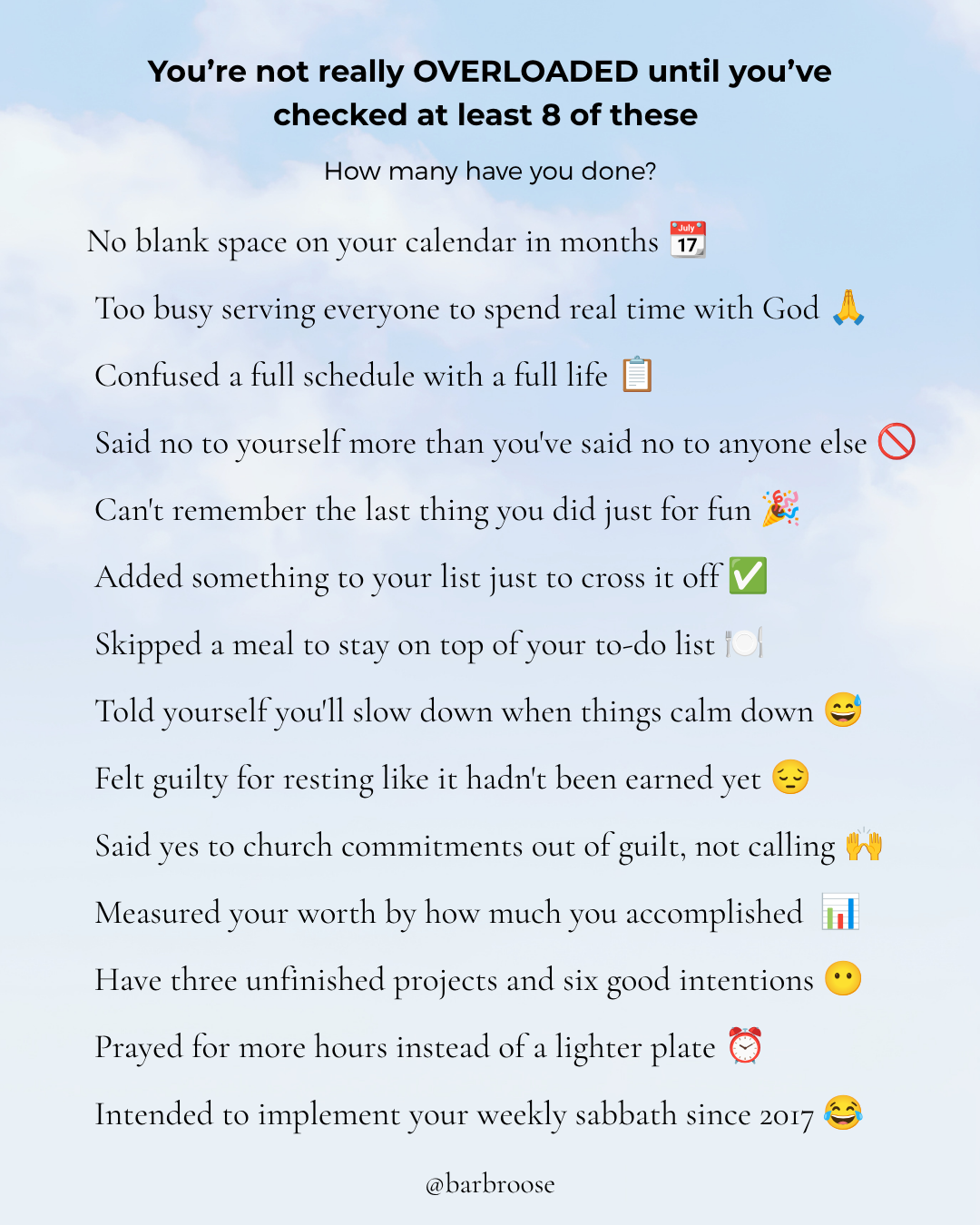
Ready for today's topic: OVERLOAD. It's quiz time! Reminder: If your score is higher than you’d like, consider that a gentle nudge from God to pay close attention to today's devotion. 
WHAT’S BEHIND OUR CHRONIC OVERLOAD?
For much of my life, “overload” was my middle name. When God began dealing with me about why the “reason-behind-the-reason” that I stayed busy 24/7, I discovered five uncomfortable “whys” that fuel chronic overwhelm for many Christian women. Which ones resonate with you?
  1. We love being needed.
  2. We want things done a certain way, so we don’t like to allow anyone’s help.
  3. We assume responsibility for people or things that aren’t our responsibility.
  4. We use our contributions or accomplishments to build our self-worth.
  5. We don’t know how to say “no” or express healthy personal boundaries.
Do you have any others to add? Which ones could you relate to? 
 
Let me add that for Christian women, there can be lots of blurry lines. Many Christian women struggle with saying “no” when people at church, especially the pastor. If no one has told you this, it maybe helpful to know that you should ask for time to pray and discern before saying “yes,” even if the pastor or another leader asks you. 
 
HOW DID JESUS AVOID OVERLOAD?
We're in the gospel of Mark today! The following Bible study is challenging, but needed, especially if you love helping people, but you've been doing too much lately.
 
At the beginning of Mark’s gospel, word about Jesus has spread. It's helpful to know that Mark's gospel focuses on Jesus as a servant. There's a lot of ministry action in Mark. Fun fact: the word “immediately” appears over thirty times in the New King James Version of Mark's gospel. So, Jesus stayed busy!
 
Mark.1 records how people traveled to hear from Jesus teach. Then, they stayed to seek healing from ailments and diseases that many couldn’t find relief from any other way. Here's how Jesus handled himself:
 
Before daybreak the next morning, Jesus got up and went out to an isolated place to pray. Later Simon (Peter) and the others went out to find him. When they found him, they said, “Everyone is looking for you.” -Mark 1:35-37 NLT
 
Even though a crowd waited for him and he was very popular, Jesus began his day by tending to his need to connect with God.
 
As Jesus spent time with God, it's not hard to imagine that Jesus reaffirmed his clarity on what to do and what not to do. Do you do ask God for clarity on everyday matters? 
 
I believe that we have freedom to seek God at a time during the day that makes sense. You don’t need to become legalistic about only mornings. But I do believe that before you look at your to-do list or your calendar, you should spend time with God. It can make all the difference to look at what you have to do after He realigns your heart and mind versus looking at it through your cram-it-in lens.
 
Next, here is how Jesus responded to Simon. It's shocking! 
 
But Jesus replied, “We must go on to other towns as well, and I will preach to them, too. That is why I came.” -Mark 1:38 NLT
 
Wait! What about the people? Jesus knew that many people needed him for earthly healing and relief. Yet, Jesus operated from a heavenly perspective. While some people would not receive what they wanted in that moment, but Jesus ultimately gave everyone what they needed through his sacrifice.
 
THAT’S CHALLENGING TEACHING, ISN’T IT?
Let’s review the radical way that Jesus lived: 
  1. Jesus took care of himself before addressing the needs of everyone else.
  2. He turned down the request to stay even though the people asked him to.
  3. Jesus did not help or heal everyone who sought him out.
  4. There’s no record of Jesus beating himself up or feeling guilty.
REFLECT OF THIS: Jesus loved people. We know that Jesus gave his life for them. At the same time, loving people didn’t mean that Jesus said yes to everything that every person asked him to do, even the people closest to him.
 
Because Jesus had clarity on what his mission was, he didn't tie his love for people into an obligation to step into every single person’s problem or situation. 
 
Read that last sentence again.
 
What do we do this? How do we apply what Jesus models to our lives? Stay tuned! We'll continue this conversation next week with practical tools on how to say “no” without guilt, learn spiritual tools that lead to freedom and more! Make sure to join me so we can grow into God's best for us together. 
 
I’D LOVE TO HEAR FROM YOU! How did you do on the quiz? What did you think about today's teaching, especially realizing that Jesus didn't help everyone who came asking? 

Read the Entire Series: God, I'm So Over It! Letting Go of Things That God Never Asked You to Carry

Do You Often Take Matters Into Your Own Hands? I’m So Over It, Week Three

Do You Often Take Matters Into Your Own Hands? I’m So Over It, Week Three

Hi friends,
 
Happy Monday to all of you, including our new friends!  I’m thrilled that you’re here!
 
It’s week three of our series, “I’m So Over It.” We're looking at the four different types of overwhelm and how God may be trying to grab our attention so we can live in more peace and less stress. In week one, we discussed overthinking, and last week, we addressed over-functioning. (You can read those devotions at the end of this week's devotion.)
 
This week’s topic is OBSESSING. Do you tend to obsess? Here’s another quiz - and remember, don't beat yourself up! 
There’s nothing wrong with desiring good, even godly things like wanting our loved ones to know Jesus. We may long for physical healing or to experience a shift in one of our relationships. However, when we’re obsessed with how things should be, the danger is that we often become impatient when our prayers aren't answered according to our timing.
 
For example, take the Old Testament couple Abraham and Sarah, who spent years waiting for  God to keep His promise to give them a child. However, there seems to be a point at which Abraham and Sarah allowed their obsession with having a child to cause them to jump ahead of God’s timeline, resulting in significantly more stress and overwhelm than they bargained for.
 
I’m sharing their story today because I think there’s a little Abraham and Sarah in all of us: When we become obsessed with what we want, we must avoid the temptation to take matters into our own hands.
 
In Genesis 12, God told Abraham that He would make then-Abram into a great nation and all the people of the world would be blessed through him.  In Genesis 15, Abram questioned that promise because he didn’t have a son. God reassured Abram that a child was coming. Here’s Abram’s response in Genesis 15:6:
 
And Abram believed the Lord, and the Lord counted him as righteous because of his faith. - Genesis 15:6 NLT
 
In that moment, Abram had a bedrock, unshakeable belief. Perhaps you've heard, “God said it, so I believe it.”  That's how we want to live, right? But then, time goes on and nothing happens. 
 
In Genesis 16, the attention shifts to his wife, Sarai. She's impatient because there's no child yet. Abram agreed to his wife’s scheme to take matters into their own hands to produce the baby that God already promised. They forced their servant Hagar into a slave surrogacy. This wasn’t God’s plan. God doesn’t fulfill His promises through manipulation or prompting us to use controlling behaviors.
 
While I acknowledge Abram and Sarai’s lack of faith in that moment, I have compassion for all the years of their infertility-related heartache. Still, their obsession put them on a collision course with many years of unneeded pain. After Hagar became pregnant, there was abuse on all sides (Genesis 16: 4-7). After Hagar’s son, Ishmael, was born, that innocent little boy grew up in a home that held the tensions and likely resentments of adults who tried to play God and got burned.
 
Yet, through it all, God remained faithful to His promise. Fourteen years later, when Abram was 100 years old, a post-menopausal Sarai gave birth to their covenant miracle son, Isaac (Genesis 21:5).  In the end, Abraham and Sarah received their miracle baby, but relationships were damaged along the way.
 
WHY DO WE TAKE MATTERS INTO OUR OWN HANDS?
It's usually one or more of these three reasons:
  1. God seems to be taking too long, and our hearts ache so much that we can’t stand it.
  2. We panic when we think of all the worst-case scenarios if what we’re praying for doesn’t happen.
  3. We’re afraid that God won’t give us what we’ve set our hearts on.
 
As you look at those three reasons, which one seems most relatable to you?
 
Just like I have compassion for Sarah, I have compassion for anyone who can relate to one of these three reasons. We don't have to beat ourselves for wanting something, but it should also prompt us to seek God’s help instead of going our own way. God invites us to share how hard it is to wait. In Psalm 13, where King David says, “How long, LORD?” four times in that one psalm! David poured his aching heart out, and that leads me to believe that God welcomes our lament and confusion when we’re in long waiting seasons as we're encouraged to keep trusting Him.
 
MY GO-TO PRAYER WHEN I’M TEMPTED TO HELP GOD OUT…
If you have a little Abraham and Sarah's impatience inside of you, then this is where God desires for you to surrender that deep desire or obsession to Him. There’s a brief prayer from my Stronger Than Stress Bible study that helps you step into trusting God. 
 
Here it is: God, I can’t. But You can. I will let You. Amen.
 
Do you need to pause right now and offer up that prayer? This maybe the most important prayer you pray today, especially if you've already been cooking up plans to deal with someone or something that is best left up to God. Stop now and pray!
 
MY OWN PERSONAL JOURNEY…
I’ve prayed for a spouse over five years. After fighting for my first marriage for many years, God healed my heart after my long, sad divorce. I was surprised that I would have a healthy desire for a second chance at love and marriage. But, the road hasn’t been easy. Either I’ve been criticized for wanting to remarry, told that I’m too old, too tall, or rejected because I’m abstinent until marriage (which has been the biggest issue by far!), waiting on God amid this deep desire has been hard. Yet, this journey continues to draw me closer to God as I wait instead of taking matters into my own hands.
 
I know that many of you can’t relate to my specific situation, even though some of you can. Maybe you’re wrestling with a desire to purchase a particular house, car, or possession, but the finances aren’t there yet. Perhaps your spouse isn’t going to church, and you’re tempted to use manipulation, nagging, or guilt to get them to attend. Some of you are navigating a long infertility journey like my daughter, Sami, and you've been praying for years for children. Whatever it is, there will always be a temptation to take a shortcut and grab what God hasn’t given to you yet. Getting what we want can't fill us like only God can.
 
PRACTICAL THINGS THAT HAVE HELPED ME
While there are seasons when I handle the longing desire better than others, I’ve chosen to anchor my soul into these words from Psalms 84:11:
 
The Lord will withhold no good thing
   from those who do what is right.
 
This psalm doesn’t promise that God will give us whatever we want, rather, the psalmist reminds us that God will not withhold all the goodness that comes from His nature as our Abba Father and Almighty God. When we fix our minds onwho God is  and live like we trust Him, we receive God's best for us right now. Here's what anchors my spirit when my feelings are all over the place:
 
I am receiving God’s best for me right now because God is with me at all times.
 
Here are three practical ways to live out trusting God while we wait:
  • Instead of lying awake all night thinking of how to get what we want, we turn on a worship song and focus on God so we can rest in His peace (Isaiah 26:3).  
  • Instead of thinking of worst-case scenarios if it doesn’t turn out as we’d hope, we practice gratitude and remember God’s faithfulness (Lamentations 3:22-23).
  • If we’re afraid we won’t get what we’d hoped for, we replay God’s promises and remember that He never withholds any good thing from us (Psalm 84:11).
 
I’D LOVE TO HEAR FROM YOU! What was your score on today's quiz? You can leave a comment and let me know. What has weighed heavy on your heart lately that you need to surrender to God? If today's devotion resonated with you, feel free to leave a comment with “surrender" so I'll know!

Read the Entire Series: God, I'm So Over It! Letting Go of Things That God Never Asked You to Carry

When Your Mental Health Messes with Your Faith | Interview with Dr. Jean Lee Neely

When Your Mental Health Messes with Your Faith | Interview with Dr. Jean Lee Neely

So many Christians struggle with mental health, and yet we still struggle to talk about it without shame. If you’ve ever struggled with anxiety, depression or sadness because no one understands, this episode is for you.

In this honest and deeply compassionate conversation, Barb is joined by author Jean Neely to discuss her book Christ in the Abyss: Cultivating Deep Faith amid Depression and Despair. Drawing from her own decades-long journey with mental health challenges, Jean offers a powerful reminder: God’s presence isn’t reserved for when we feel strong—it meets us right in the depths of our pain.

Together, they explore how Christians can approach depression and mental health with honesty and faith, what to do when struggles begin to shake your beliefs, and how to navigate doubt when God feels silent. This episode offers reassurance that God sees you and loves you, even at your lowest points.


RESOURCES FROM THIS EPISODE

Connect with Jean on Facebook

Connect with Jean on Instagram

Christ in the Abyss: Cultivating Deep Faith amid Depression and Despair

Visit Jean's Website

Read from Jean's Substack

ABOUT OUR SPECIAL GUEST

Jean Lee Neely is a Korean American writer and educator. She has degrees in comparative literature from the University of California, Irvine and Sorbonne University in Paris and a PhD in English literature from the University of Southern California. Jean writes regularly on issues of mental health and faith for Faith and Leadership, a resource from the Duke Divinity School for Christian leaders. She has also written for Sojourners, Inheritance, the Asian American Christian Collaborative (AACC), and Christians for Social Action. She has taught seminars on navigating the intersections of faith, spiritual formation, and mental health for college students and Christian faculty. She lives in Southern California with her husband and son.

Experience Life-Transforming Power of Prayer

Pray Like This Bible Study by Barb Roose

As a Christian, you know you’re supposed to pray. But do you ever find yourself wrestling with any of these questions related to prayer?

Do I have to pray the right way for God to answer my prayer?

Do I have to pray the right way for God to answer my prayer?

Am I still praying if I read pre-written prayers?

If you’ve pondered these questions or others about prayer, my Pray Like Bible Study is for you.

Even if you're a prayer warrior, Pray Like This sharpens your prayer focus and is a great resource for you to teach others about prayer.There's a reason why Jesus was passionate about prayer and I want to show you how!

Hope for Those Who Do Too Much! I’m So Over It, Week Two

Hope for Those Who Do Too Much! I’m So Over It, Week Two

Happy Monday, friends,
 
Wow! Lots of emails came in after last week’s kickoff of our I’m So Over It” series. Thank you for sharing your quiz scores and your resolve to overthink God instead of overthinking everything else. It was an honor to pray for you all!
Today is the second week of our series, and we’re tackling a topic that happens to be one of my personal struggles: OVERFUNCTIONING.
 
Do you overfunction? Not sure what that means or looks like? I created an overfunctioning quiz, but please don't beat yourself up! Happy Monday is a 100% grace place! We are all on this journey together. God sees us and loves us as we are. These self-assessments are invitations, not indictments on our worthiness or faith. Once you take the quiz, then invite God to speak as you read the rest of today’s devotion. Here’s the quiz:
How’d you do? Confession time: If I'm in an unhealthy place, I will hit the maximum score every time.  What about you? If we peel back the layers of overfunctioning, our doing-too-much dysfunction comes from a good place. As women, our goal is to protect what we love, fix what’s broken, and keep everyone and everything on track. However, when we’re not aware of our motives, we’re driven by guilt, or we’re afraid for any reason, our good intentions morph into unhealthy overfunctioning.
 
LET'S LEARN FROM AN OLD FRIEND
There’s a New Testament woman who was stressed because she was doing too much. We’ve covered her story in a past Happy Monday series, but let's look at her story again from a different perspective. Even if you know the story of Martha and Jesus, pay attention to Jesus’ compassionate but very insightful response to Martha’s frustration.
 
As Jesus and the disciples continued on their way to Jerusalem, they came to a certain village where a woman named Martha welcomed him into her home. Luke 10:38 NLT
 
Notice that Martha welcomed Jesus and his entourage with open arms. This shows us Martha’s heart came from a good place. It’s so easy for us to be critical of Martha, but let’s not overlook her strengths. Some of us are Marthas. Even if you’re not, let’s appreciate:
 
It’s the Marthas who know how to cook and they remember to buy all of our favorite breakfast foods.
 
It’s the Marthas who spread the good-smelling sheets on the beds, and they love making sure everyone is taken care of.
 
I point these reminders out so we don’t overlook the good in Martha. However, here’s where Martha lost herself:
 
But Martha was distracted by the big dinner she was preparing. -Luke 10:40 NLT
 
So any of us could relate to Martha's to-do list and her angst, but chances are Martha was doing more than needed because of her personal motives. In the midst of doing good things, Martha lost sight of her identity as a child of God.
 
This happens to so many of us. We make taking care of others our life’s purpose. Taking care of others can give us purpose, but let’s not confuse caring for others as our sole sense of purpose or identity. Our identity is God's child, not taking care of others or a specific job. Too many of us hace attached our identity to what we do for others -  or worse yet, taking over for people who should be taking care of themselves.
 
This is why Jesus says the following to our friend, Martha:
 
There is only one thing worth being concerned about. Mary has discovered it, and it will not be taken away from her. -Luke 10:40 NLT
 
Yes, Jesus affirmed Mary’s desire to sit and learn at his feet. At the same time, Jesus included a reminder to Mary that she was more than what she could do for others. Martha needed to know that she didn’t need to earn her self-worth by serving others. As I wrote in Stronger Than Stress, God created us as human be-ings, not human doings. Just being a child of God is always enough.
 
MY OVERFUNCTIONING A-HA MOMENT
For so many years, I performed Christianity because I felt like God would love me to the extent that I did things that made Him happy. But, this error in understanding grace led to faith where I was always doing for God like Martha, but struggling to sit with God like Mary.
 
I transferred this overfunctioning mindset into my relationships. It seemed to work when I was a young wife and mother. My good intentions became dysfunctional when my then-spouse struggled with alcohol addiction.  When I felt my marriage slipping away, I kicked into overfunctioning overdrive. I’d checked every one of those on the quiz. And I was miserable because I was doing too much out of fear and a desire to fix what only God could handle.
 
The a-ha moment came when I began attending a family addiction support group meeting back in 2016 and learned one important slogan that has helped me so much:
 
"Keep your eyes on your own hula-hoop."
 
This means that I need to take care of the things that I’m responsible for. Then, I need to be aware of not inserting myself into things that God is responsible for, which is other people and circumstances beyond my control. I learned how to do less to make room for God to do more.
 
Where do you need to “keep your eyes on your own hula hoop”? If you’re not sure, look back at that quiz.
 
ASK THESE QUESTIONS BEFORE YOU OVERFUNCTION
There are certain phrases that overfunctioners tend say. I've listed a few below. If you recognize these, consider where God maybe prompting you to back off because you're doing to much. Take this pause seriously because you maybe jumping into territory that are actually where God is working and you maybe getting in the way.
 
1. Instead of automatically saying “Don't worry, I’ve got it.”
Ask: Should someone else take care of this, especially if I am tired or I haven’t been consistent with time with God or my own self-care?
2. Instead of saying, “I’ll take care of it.”  
Ask: Am I responsible for this, or am I overstepping where someone else should be taking the lead instead of me?
3. Instead of  saying“No problem, I want to do it.”
Ask: Am I doing it because I like feeling needed, or am I afraid that someone won’t do it as I would?
 
I’D LOVE TO HEAR FROM YOU! What was your score on today's quiz? You can hit reply and let me know. Could you relate to Martha's story today? If so, I'd love to hear about it, or you can leave a comment with “Do Less” and I'll know today's devotion resonated with you.

Read the Entire Series: God, I'm So Over It! Letting Go of Things That God Never Asked You to Carry

Do You Overthink? I’m So Over It, Week One

Do You Overthink? I’m So Over It, Week One

Happy Monday everyone,
 
Today is the kickoff of our new series called “I’m So Over It!” This series aims to tackle the four ways we experience overwhelm. Put a mental checkmark on the one(s) that you can relate to. We’ll address one of these each week with scriptural wisdom:
  • Overthinking - Trying to control situations with our thinking, but unable to make decisions
  • Overfunctioning - Taking on people and things we’re not responsible for
  • Obsessing - Fixing our expectations on a specific outcome
  • Overloaded - Shouldering more than we can handle
Let me add this: There’s nothing wrong or sinful in experiencing overwhelm. There’s no need to beat ourselves up or feel ashamed.  However, when we know we're struggling, that’s when we must realize that God is trying to get our attention. God promises freedom, but our part is to allow God to work in us because far too many of us are holding on to things God has never asked us to carry.
 
TODAY’S TOPIC: OVERTHINKING!
 
Do you overthink? Not sure? Here’s a fun, but helpful temperature check. Count how many apply to you - and feel free to hit reply and tell me your score. Note…please don’t overthink this exercise. Make sure to keep reading for today’s teaching!
Today, let’s look at the story of an Old Testament man that I consider an overthinker in the Bible by the name of Gideon. The words “overthinker” or “overthinking” are not specifically mentioned in his story. However, as we focus on Gideon’s story, he’s rocking an overthinking vibe, for sure!
 
You can read Gideon’s story in Judges 6. We’re introduced to his situation before we meet him. The Israelites are in the Promised Land, and their leader Joshua is dead. Sadly, God’s people broke their promise to serve God with their whole hearts. So, God allowed attackers to go after the Israelites. Judges 6:6 sums up the dire nature of the situation:
 
So Israel was reduced to starvation by the Midianites. Then the Israelites cried out to the Lord for help. -Judges 6:6 NLT
 
Afterward, God sent a prophet to tell the people that they’d messed up by worshiping other gods. He also set a rescue plan in motion. An angel (whom we’ll later see is God) visits a man named Gideon who is hiding in a winepress. Pay attention to how the angel greets Gideon and keep this in mind as we read Gideon’s later responses:
 
The angel of the Lord appeared to him and said, “Mighty hero, the Lord is with you!” -Judges 6:12 NLT
 
There are two important pieces of information in that greeting: First, Gideon is called a hero, and the angel says that God is with him. Now, at the time, this goes right over Gideon’s head. He is hiding in a winepress, trying to secure food that the Midianites can’t steal. Gideon also feels pretty sure that God has abandoned His people. We can see that Gideon is skeptical of the angel’s words because of the hardship.
 
Undaunted, the angel (who we learn is actually God) tells Gideon about the mission: he will rescue Israel from the Midianites. Best of all, the angel assures Gideon that no special skills are required:
 
Then the Lord turned to him and said, “Go with the strength you have, and rescue Israel from the Midianites. I am sending you!” -Judges 6:14 NLT
 
God’s words should have made Gideon excited! Here was a chance for a powerless Gideon to set out with God’s power to free the Israelites. Instead of climbing out of the winepress and shouting “Let’s gooooo,” Gideon had a “But.”
 
But Lord,” Gideon replied, “how can I rescue Israel? My clan is the weakest in the whole tribe of Manasseh, and I am the least in my entire family!” -Judges 6:15 NLT
 
God gave Gideon a promise and Gideon’s first word back to God was a “but.” Sometimes, “but” is a polite way of saying, “nope.” God has told the man to go, and Gideon’s brain spit out not one but TWO reasons that God’s promises couldn’t be true.
  
WHAT’S YOUR “BUT, GOD?”
 
How many of us struggle to trust what we read about God in the Bible?  We second-guess God’s unconditional love or His promises to forgive. Some of you who believe in God’s love or grace at 99%. It’s true for you 99% of the time, but there’s that 1% that you’re not sure about. So you question it, you’re anxious about it, which means you never fully rest in it.
 
Here’s what I’ve learned about overthinking…Often, the roots of our constant rethinking stretch back to our younger years, when we tried to figure out how to meet our needs for safety, love, or belonging. We spent those years paying attention to what drew attention, what was rewarded, or what we needed to avoid. So, we became pros at scrutinizing every single detail.  
 
What made us feel safe as kids can make it challenging to trust God as an adult.  We’re so used to picking apart, second-guessing, or being skeptical that we struggle with trusting God. We pick up our Bibles, we look at verses about God’s love, grace, or the promise of His presence, and we have our own “But God” issues.
 
Look at the first five words of God’s response to Gideon’s overthinking error:
 
The Lord said to him, “I will be with you. And you will destroy the Midianites as if you were fighting against one man.” -Judges 6:16 NLT
 
Once again, God assures Gideon that He will be with him. God promised Himself. I will be with you. It’s the same promise we experience in the Person of Jesus Christ, our Emmanuel, which is that God is with us. For all of the reasons why Gideon didn’t think success was possible, God reminded him that those reasons didn’t matter because God was with him.
 
I encourage you to read Gideon’s story in Judges 6. After a few more false starts, Gideon finally set out on the campaign to rescue God’s people. But, Gideon kept asking God for reassurance that he was on the right track. He kept coming up with reasons that kept him from believing God’s promise to be with him.
 
Can you relate?
 
A CHALLENGE FOR A DIFFERENT KIND OF OVERTHINKING!
 
Instead of overthinking negative thoughts, catastrophizing, or trying to control, I’d like to challenge you to think differently. It's time to drop our “but's” and fully embrace what God says is true. Here's the challenge: What if we committed to overthinking God’s presence and His provision? 
 
If we're overthinking other things, then we're underthinking God. Let's flip that! When we’re overthinking God, we’re fixed and focused on God's presence and power. Here’s a short list of what that means for me and you:
 
God promises peace in every situation. (Philippians 4:7)
God promises grace upon grace. (2 Corinthians 12:9)
He promises strength to endure. (Romans 5:3-5)
He promises divine wisdom when it’s needed. (James 1:5)
God promises unconditional love. (Romans 8:39)
 
Who's going to overthink God with me this week? I dare you to try it! Whenever you catch yourself puzzling over a conversation, text message, big problem or frustration, shift to my list about God’s promise to be with you and overthink that.
 
For me, overthinking shows up most often in situations where I feel out of control or where I'm feeling rejected. So, overthinking about God in those situations replaces my fears and sadness with God's peace and His love. That feels way better than all those negative thoughts!
 
PRACTICAL APPLICATION
If you’re an overthinker, this isn’t a switch you can flip off without God’s help. Here are some spiritual practices that I’ve done and God’s Spirit helped me to let go of a lot of overthinking:  
 
  1. God Morning/God Night Technique - This is easy! Write five promises of God on a notecard and set it by your bed. (I also taped a card to my bathroom mirror.) Read those promises each morning and each night to train your mind to meditate on God, not your problems. Here’s a resource on this.
  2. Journaling - Writing down your thoughts helps you notice where you’re overthinking and where you need to invite God in to help you stop fixing things in your mind.
  3. Ask yourself these clarifying questions: Is this a situation or problem that I need to solve right now? Is this my problem to solve, or do I need to surrender it to God?
 
I’D LOVE TO HEAR FROM YOU! What was your score on the “Are You An Overthinker”? You can leave a comment and let me know. If you need to let God work on your overthinking this week, just message me with “Overthinker” and I can pray with you this week.

Read the Entire Series: God, I'm So Over It! Letting Go of Things That God Never Asked You to Carry

A Biblical Path to Healing From Racial Trauma | Interview with Sheila Wise Rowe

A Biblical Path to Healing From Racial Trauma | Interview with Sheila Wise Rowe

In this powerful and hope-filled conversation, Barb speaks with counselor, spiritual director, and author Sheila Wise Rowe about her book Seeds of Racial Healing: Fifty-Two Devotions for Navigating Through Trauma. With over thirty years of experience counseling trauma survivors and ministering to marginalized communities, Sheila offers a deeply compassionate, trauma-informed approach to addressing both personal and systemic racism through the lens of Scripture.

They talk about how racial trauma impacts the body and soul, why rest and resilience are essential for Christians of color, and how being rooted in God’s Word can nurture healing and justice. 

If you are seeking Christian encouragement, spiritual formation, and practical tools for navigating racial trauma, this conversation offers hope, wisdom, and a path toward renewal.


RESOURCES FROM THIS EPISODE

Connect with Sheila on Facebook

Connect with Sheila on Instagram

Seeds of Racial Healing: Fifty-Two Devotions for Navigating Through Trauma

Visit Sheila's Website


ABOUT OUR SPECIAL GUEST

Sheila Wise Rowe (MEd, Cambridge College) has over thirty years of experience offering counseling and spiritual direction to individuals, couples, leaders, and trauma survivors. Sheila also spent a decade ministering to unhoused and abused women, children, and youth in Johannesburg, South Africa, where she was a lay pastor and taught Christian counseling and trauma-related courses. Sheila is a speaker, trainer, and writer, authoring the award-winning Healing Racial Trauma and Young, Gifted, and Black. She and her husband, Nicholas Rowe, live in Boston, Massachusetts, and coauthored Healing Leadership Trauma.

Experience Life-Transforming Power of Prayer

Pray Like This Bible Study by Barb Roose

As a Christian, you know you’re supposed to pray. But do you ever find yourself wrestling with any of these questions related to prayer?

Do I have to pray the right way for God to answer my prayer?

Do I have to pray the right way for God to answer my prayer?

Am I still praying if I read pre-written prayers?

If you’ve pondered these questions or others about prayer, my Pray Like Bible Study is for you.

Even if you're a prayer warrior, Pray Like This sharpens your prayer focus and is a great resource for you to teach others about prayer.There's a reason why Jesus was passionate about prayer and I want to show you how!

The Topic That I Tried to Skip Writing About… Loaves & Fishes Week Six

The Topic That I Tried to Skip Writing About… Loaves & Fishes Week Six

​Happy Monday, friends!

 
Welp, this isn’t how I planned to wrap up our Loaves & Fishes series. I’ve skipped over this story on my Loaves & Fishes planning list because it hits close to home for many of us. Yet when I prayed about what to prepare for you, I felt prompted to write this story - maybe God wanted me to write it for me. I suspect that some of you will resonate with it as well. Today's devotion reminds us that as we’re praying for God’s provision, we must avoid a critical mistake after we receive it.
 
The theme of today’s devotion is this: Never take God’s provision for granted.
 
In the Old Testament book of Numbers, the Israelites were upset about God's solution to their food problem. After freeing them from slavery in Egypt, God sent literal food from heaven every single day for them. Many of us are familiar with this well-known story, but if you aren’t, I wrote about this miraculous provision in the first week of the Loaves & Fishes series that you can read here.
 
While Exodus 16 provides an introduction to the arrival of manna, Numbers 11 offers more specifics about this heaven-sent food. Pay attention to the description of manna and the different ways the Israelites could prepare it:
 
The people would go out and gather it from the ground. They made flour by grinding it with hand mills or pounding it in mortars. Then they boiled it in a pot and made it into flat cakes. These cakes tasted like pastries baked with olive oil. -Numbers 11:8 NLT
 
First, remember that God provided home delivery - how cool is that?! Next, there was a process to preparing the manna, which offered the Israelites a daily routine and a sense of purpose. We forget that God’s provision is often tied to meaningful work and a chance to serve others - which was also good for the Israelites' emotional and mental health.
 
The problem arose when the people grew tired of manna.  Instead of seeing it as God's gift of provision, they began to take the manna for granted. They stopped being grateful for it. This happens to us as well. Some of us take our jobs or even our family for granted. We stop seeing these as gifts (remember, gifts don't have to be perfect or problem-free to still be a gift). The dark side of assuming that someone or something will always be there is that we begin to compare it, we'll critique it - and often complain about it.
 
Ever heard the saying “familiarity breeds contempt?" This describes what happened next in Numbers. Check out the Israelites' complaints. Pay attention to how they romanticized their time back in Egypt:
 
“Oh, for some meat!” they exclaimed. “We remember the fish we used to eat for free in Egypt. And we had all the cucumbers, melons, leeks, onions, and garlic we wanted.  But now our appetites are gone. All we ever see is this manna!” -Numbers 11:4b-6 NLT
 
So that’s how they remembered Egypt? How quickly they forgot the beatings, nonstop labor, and brutal control? Many of those mothers had freshly empty arms from the babies that the Pharaoh ordered to be killed. But, they chose to complain about heaven-sent manna?
 
As much as I want to roll my eyes at the Israelites’ complaining, I am them. They are me.
 
How many of us begged God for a particular dream, job, home, spouse, or kids? Then, years later, we’re complaining about the burdens that come with great blessings. Trust me, I’ve complained, too.
 
If you’ve been grumpy about your blessings or complaining about life, let’s invite God to do some business in our hearts. Then, I’ll share two great ways to step out of your rut of complaining.
 
First, we can acknowledge pain, loss, grief, or disappointment. We don’t have to minimize or deny it.
 
However,  there is a difference between acknowledging and complaining.
Acknowledgment recognizes the facts. If your company withholds your pay, you should acknowledge that and the harm it causes. If your medical condition is painful or you're afraid for the future, it’s okay to be scared.  For those caring for loved ones, you can acknowledge the overwhelm and exhaustion.  
 
Complaining is different. When we take the facts and add negativity or blame, there's an unspoken, but implied allegation that God isn't treating us right or that He's gotten something wrong. This is why regular  complaining is a warning sign for our spirits. Yes, it's tough in our world, but you here today by the grace of God and He will not fail you..
 
God takes complaining seriously. In my humble opinion, complaining is the decaf of bitterness. As Christians, we know full-on bitterness is bad, but we’re willing to allow grumbling to slide. But, God takes complaining seriously.
 
In the Israelites’ situation, they groused about the lack of meat, so God sent a wind filled with quail. The Israelites were delighted! However, instead of gathering what they needed, they filled Costco-sized shopping carts of birds, grabbing far more than needed. They stuffed their mouths and stomachs like starving people without a God who took care of them. The result was tragic because God allowed a food borne illness of some type that killed significant numbers of people.
 
You want to know a kicker to this entire situation? God never prohibited the Israelites from hunting for meat! They could have gone hunting at any time. But their negativity consumed any productive or problem-solving conversations. A tragedy all around.
 
Like I said, this wasn’t the way that I wanted to end our Loaves & Fishes series, but if we’re praying for God’s provision in our lives - no matter what it is - then we must be mindful of how we behave after God’s blesses us.
 
Did today's devotion grab your attention? Is God prompting you to shift from negativity to remember His kindness to you? Give yourself a few moments to reflect.
 
REFLECTION & APPLICATION:
  1. Do you give in to your complaints for just a moment, or do your complaints have momentum? Meaning, do you interrupt yourself when you realize that you’re complaining, or has complaining become a habit?
Do This: If complaining is a habit, I’d love for you to check out my dear friend Melissa Spoelstra’s 7-Day Contentment Project (here). Her fabulous challenge involves wearing a bracelet on your wrist that you switch from side to side. This helps you become more aware of when you’re complaining.
 
2.  WORSHIP MUSIC - Music that focuses on God’s power or grace reminds us that we’re held by a loving, powerful God! For me, a worship song a day helps keep constant complaining away! Friend, if you complain either in your mind or to others, it’s time to talk less and worship more! Check out my Spotify worship playlist here!
 
I’D LOVE TO HEAR FROM YOU! If you needed today’s devotion, leave a comment with “no complaining!” Of course, you’re welcome to tell me more - especially if today’s devotion resonated with you.

HAPPY MONDAY READER'S LOAVES & FISHES STORY!

I love this Loaves & Fishes story from Jenny, a Happy Monday reader:
 
I remember that I looked at what we had in the fridge & cupboard, I did not have all that was needed for the next day. I did have some food, but not enough pennies to buy both bread and milk. At 7pm, there was a knock on my door. It was a neighbour, who I only knew a little. She recalled that I had been a nurse and asked if I would have a look at her son's big toe. I went and looked. The toe looked broken so I sent them to A&E (Emergency Room). 
 
The next morning, that neighbour showed up with two large loaves of homemade bread as a thank you! It was amazing!! A big thank you Lord, I then had enough pennies to buy the milk we needed for the day! The bread was very yummy! A small need, but a God who heard & cared & provided.

Read the Entire Series: Loaves & Fishes Stories Of Trusting God's Provision In Uncertain Times!

God Provides. Are You Willing to Ask for Help? Loaves & Fishes Week Five

God Provides. Are You Willing to Ask for Help? Loaves & Fishes Week Five

Happy Monday, dear friends!
 
We’re continuing our summer series, Loaves & Fishes. We're exploring stories of God's provision to remind us how our Abba Father cares for us and invites us trust Him, even in uncertain or tough times.
 
In today's Old Testament story, God comes through in a powerful way for a woman who was about to lose her sons. We'll also address a very important secondary lesson that you may need today as well. Don't miss it!
 
In 2 Kings 4, we’re introduced to an unnamed widow. We find out her late husband was a prophet, a messenger for God. She comes to the prophet Elisha, a powerful figure in the Old Testament with a desperate plea: 
 
‘My husband who served you is dead, and you know how he feared the Lord. But now a creditor has come, threatening to take my two sons as slaves.” -2 Kings 4:2 NLT
 
According to Jewish law, if someone was in debt, their family members could be taken as payment and forced into labor. So, this woman was about to lose her sons. 
 
The widow was not only grieving, but also overwhelmed by the inability to pay her debt, and now the fear of more loss. Ancient women didn't have their own money, social security, or government assistance. Therefore, losing her sons would be tragic on several levels. In addition to the familial bond, those sons would have been her future financial support, potentially keeping her from becoming destitute.
 
Can you relate to the downward domino effect of her life? Often, it's not one thing that goes wrong, it feels like everything goes wrong! Those seasons seem overwhelming. We're not sure what to do and often, we become discouraged and afraid.
 
This is why I love Elisha’s response to the woman's outcry:
 
“What can I do to help you?” Elisha asked. “Tell me, what do you have in the house? “Nothing at all, except a flask of olive oil,” she replied.” -2 Kings 4:2 NLT
 
Bless him! Elisha didn’t tell the woman to calm down or minimize her problems. He gave her a voice and asked what she needed. Then Elisha posed a question similar to the one that Jesus asked the overwhelmed disciples before he performed the miracle that fed 5,000 people: "What do you have?"
 
In fact, the miracle that follows for this woman has a similar vibe to Jesus’ feeding the five thousand. Just like the little boy only had two fish and five loaves, the woman only had a flask of oil - it wasn't much. However, there's nothing too little for God to work with!
 
Pay attention to what Elisha told her to do. Also, notice everyone (underlined) involved in what happens next:
 
And Elisha said, “Borrow as many empty jars as you can from your friends and neighbors. Then go into your house with your sons and shut the door behind you. Pour olive oil from your flask into the jars, setting each one aside when it is filled.”
 
So she did as she was told. Her sons kept bringing jars to her, and she filled one after another. Soon every container was full to the brim!
 
First, God didn't show the needed provision all at once. As the widow poured from what she had, God made the miracle happen. (Remember the devotion of the feeding of 5,000 - same vibe!)
 
Here’s the final result: Her little flask of oil was poured until every jar was filled. Then, Elisa gave her these instructions:
 
“Now sell the olive oil and pay your debts, and you and your sons can live on what is left over. -2 Kings 4:7 NLT
 
Not only did God provide enough for her debts to keep her sons from slavery, but also, there was enough for their future. Look at God!
 
THE SECONDARY LESSON WE CAN’T MISS!
 
God performed this miracle, but the fullness of her provision came through her willingness to step out in faith and ask others for help.
 
Elisha told the widow that she needed to borrow as many empty jars as she could from friends and neighbors. It wasn’t like the widow had money to buy extra jars from Target or HomeGoods. Going to friends and neighbors would have meant telling them about her true circumstances. There would have been awkward questions, maybe even embarrassment, gossip, or shame.
 
Imagine if she’d only gone to one or two friends. I can’t say for sure, but I think God would still have performed the miracle, though she may have missed out God's very best planned for her.
 
Most of us prefer to help others, and we’d rather not need help. But, we all need help at times!
 
If you’ve done my Surrendered Bible study, there's story on page 146 about when my girlfriends asked to help me move out due to my then-spouse’s out-of-control alcohol addiction. I didn’t want their help. I was embarrassed. My family was falling apart and I  needed  to move from my large home into a two-bedroom apartment. Even though the move was too big for me to handle with my kids, I thought that I could deal with it so no one would be around to see me fall apart. 
 
My dear girlfriends were gently persistent. Two weeks before the move, there was a breakthrough moment during my time with God. Here’s how I wrote about it in my Surrendered study: 
 
“I felt the conviction of the Holy Spirit. I felt a whisper that sounded like “Are you going to make this about you? When your daughters look back on that difficult day, they need to remember that they saw the hands and feet of Jesus loving and taking care of them." 
 
In my efforts to control that day, I would rob my daughters of Jesus-loving friends and family who could love and serve them.”
 
That day, I said yes to my friends. Then, a group of men from my church’s Celebrate Recovery ministry also asked if they could help. I was still embarrassed, but grateful.  I said yes. At the end of moving day and an ocean of tears, one of the men said to me: “Years ago, I messed up my family. Helping you today healed something inside of me. So, thank you for letting me help you.”
 
To this day, I'm grateful that God sent friends to nudge me through my embarrassment and pride so that God could use them to bless us. It wasn't just how friends showed up to help us move, but they were there - present and praying for us before, during, and after.
 
REFLECTION QUESTION:
Dear friend, if you’ve been praying for God to provide AND good-hearted people are asking, do you need to say yes? If someone hasn’t asked, do you need to be courageous like the widow and ask** for help from those who have the capacity to help?
 
**Be wise about who you ask for help! Ask people who are most likely to follow-through and will not complain about helping. Avoid asking people who will shame/gossip or will expect something in return. 
 
TELL ME WHAT YOU THINK! Which part of the widow’s story made you smile or encouraged you? Leave a comment and tell me about how God has used others to miraculously bless you. 

Read the Entire Series: Loaves & Fishes Stories Of Trusting God's Provision In Uncertain Times!

God Wants You to Have a Hobby | Interview with Brianna Lambert

God Wants You to Have a Hobby | Interview with Brianna Lambert

Can having a hobby help you connect more to the heart of God?

In this episode, Barb is joined by author Brianna Lambert to talk about her book Created to Play and how our hobbies can become meaningful expressions of worship. They explore why play is often misunderstood in Christian culture, how it forms us spiritually, and the unique roles we step into through our hobbies—from creator and curator to restorer and connector. Brianna also invites us to see play not as a distraction from purpose, but as a pathway to delight, community, and deeper connection with God.

If you’ve ever felt guilty for enjoying your hobbies or wondered how they fit into your faith, this conversation will give you a whole new perspective on joy, rest, and worship.

RESOURCES FROM THIS EPISODE

Connect with Brianna on Instagram

Created to Play: How Taking Hobbies Seriously Grows Us Spiritually

Visit Brianna's Website


ABOUT OUR SPECIAL GUEST

Brianna Lambert is a writer and author from a rural community outside Indianapolis. Her articles and essays have appeared in Christianity Today, The Gospel Coalition, Common Good, Mere Orthodoxy, and elsewhere. Brianna also serves on staff at Gospel-Centered Discipleship and writes for the women’s ministry at her local church. You might find her backpacking, camping, waterskiing, or starting a brand-new hobby with her husband and three children.

Experience Life-Transforming Power of Prayer

Pray Like This Bible Study by Barb Roose

As a Christian, you know you’re supposed to pray. But do you ever find yourself wrestling with any of these questions related to prayer?

Do I have to pray the right way for God to answer my prayer?

Do I have to pray the right way for God to answer my prayer?

Am I still praying if I read pre-written prayers?

If you’ve pondered these questions or others about prayer, my Pray Like Bible Study is for you.

Even if you're a prayer warrior, Pray Like This sharpens your prayer focus and is a great resource for you to teach others about prayer.There's a reason why Jesus was passionate about prayer and I want to show you how!

Don’t Worry About Everyday Life! Loaves & Fishes Week Four

Don’t Worry About Everyday Life! Loaves & Fishes Week Four

It’s week four of our Loaves & Fishes series about stories in the Bible that show us God’s provision for us. Today’s Happy Monday devotion dips into the last portion of Matthew 6, which is the middle part of Jesus’ longest message, his Sermon on the Mount (Matthew 5-6). 
 
In this portion of scripture, Jesus addresses money, possessions, anxiety, and trusting God with the future. Everything that Jesus taught the ancient crowds is so relatable to our lives today.
 
Are you ready to do a giant exhale today? So many of you have a lot going on! God knows you’re overwhelmed, but He doesn’t want you to carry it, because He cares for you. So, I want to pray for you before we jump into today’s devotion:
God, I’m so glad that my Happy Monday sister is here today. My hope is for Jesus’ words to spark fresh hope in life. God, for the next few minutes, please remove the distractions and open her heart to Your hope and the promises she needs to cling to today. Amen.
 
Now, let’s jump into three verses toward the end of Matthew 6. I’m sharing three practical meditations for you to focus on when worry sets in:
  1. Keep Your Eyes on God, Not Everything Going on Around You
“That is why I tell you not to worry about everyday life—whether you have enough food and drink, or enough clothes to wear. Isn’t life more than food, and your body more than clothing?  -Matthew 6:25 NLT
 
What did Jesus mean when he said, “Don’t worry?” He means don’t worry! There’s not need to look for deeper meaning in Jesus’ teaching. Jesus wants us to stop assuming the worst will happen. 
 
I heard someone say that “worry is a form of atheism.”’ While I leave room for medical anxiety where our nervous systems need medical attention, there are other forms of anxiety of our own making. When we forget about God, and we carry the things God never told us to carry. That’s what Jesus tells us to stop doing.
 
Jesus didn't telling the crowd to ignore their problems. He saw their reality. The Jewish people faced brutal Roman oppression and food scarcity. I have a tender spot in my heart for the Jewish women in the audience. I imagine they worried everyday about how much food they had and how to stretch it. I'm sure they worried about their children as well as their sons, brothers, or husbands who had to go out and find food.
 
Yet, Jesus told the crowd not to worry because he came to bring the kingdom of heaven to earth. In God's kingdom, God takes care of His own.  One of the hallmark of a disciple is trusting God to take care of our daily lives so that we can focus on being the light of Jesus in the world. 
 
While we can't control our circumstances, we can change how we think. The key line in my Joshua: Winning the Worry Battle Bible study is: The difference between worry and worship is who you’re talking to.
 
REPEAT THIS MEDITATION: If you need to refocus your mind away from worry,, here’s a brief meditation from my Winning the Worry Battle book you can repeat to yourself whenever the worry creeps in.
 
God is here, and He is taking care of this.
God is here, and He is taking care of me.
 
2. You matter to God
 
Look at the birds. They don’t plant or harvest or store food in barns, for your heavenly Father feeds them. And aren’t you far more valuable to him than they are? -Matthew 6:26
 
Silly, but real question: Do you ever see birds clocking in for work? Have you ever watched a bird work overtime?
 
Clearly, I’m being dramatic, but take a moment and consider that birds don’t have to do a single thing, and God cares for them.
 
Friend, God is committed to doing the same for you.
 
Yet, I suspect that many of us will hear God say one of the following - or both,
Dear daughter, you were doing way too much.
Beloved, you didn’t trust that I loved you enough to take care of you.
 
Over the years, I’ve heard from many discouraged Christian women who look around at unanswered prayers or endless hardships and wonder, “Does God have favorites?  I keep getting the short end of the stick.”
 
If this is you,I hold space for your unanswered prayers, I grieve your losses, and at the same time, I must remind you of God’s care and love for you. Here’s an eternal perspective that many lose sight of:
 
The measure of God’s love isn’t that He gives us everything we want. The measure of His love is giving Jesus to die for our sins so that we can have a relationship with God. Furthermore, God doesn’t always give us what we want, but He always provides what we need. He  provides peace, strength, courage, hope, and purpose - often this is the provision we need more than anything else!
 
REPEAT THIS MEDITATION: I matter to God. He cares about me.
 
3. For Every Worry, Take Time to Worship
 
Can all your worries add a single moment to your life?” -Matthew 6:27 NLT
In 2017, my dad was diagnosed with end-stage cancer. The doctors told us that Dad only had a few days to live.  I was smack in the middle of writing my Winning the Worry Battle book - how’s that for timing?
 
My head spun. But, I knew that I had a critical decision to make. My dad only had days left, so would I spend Dad’s final precious moments worrying or clinging to God’s peace? Thankfully, I could cling to God’s peace by using the meditation tools that I share in today’s devotion.
 
You  have one precious life, my dear friend. Tomorrow isn’t promised to you or those you love. Only you can choose not to let worry waste those precious moments. Give your worries and cares to God (1 Peter 5:7). Instead of worry, spend time with loved ones, visit friends, tell others about Jesus, and focus on God’s faithfulness. This is how you make the most of the precious moments of life!
 
REPEAT THIS MEDITATION: I will give myself the gift of focusing on the present.
 
I’D LOVE TO HEAR FROM YOU:  What have you worried about lately? If you plan to repeat one of this week's meditation, comment with “repeat" and let me know - and of course, you're welcome to tell me which meditation!

Ora's Prayer Challenge:

In last week's Happy Monday devotion, I shared a prayer challenge that invited you to pray without asking God for anything. I loved Ora's email back to me about what she does - and this could inspire you, too!
 
Every Sabbath morning, I don't ask for anything, but I pray in gratitude for all God has done and for the people that help with my spiritual growth. I do pray for the needs of others on the other six days. -Ora B

Read the Entire Series: Loaves & Fishes Stories Of Trusting God's Provision In Uncertain Times!

Pin It on Pinterest